Armando Maribona credits Herrera as “the spirit” behind Cuba’s first outdoor exhibition, held at Parque Albear in Havana [February 27–March 5], in his review for Diario de la Marina. The show, mounted as a protest against the lack of exhibition spaces in Havana, is widely attended and well covered by the press. Paintings are hung from trees and sculptures placed on pedestals. Herrera, Helio Armenteros (1907–?), Cundo Bermúdez (1914–2008), Pedro Pablo Mantilla (1910–?), and Arturo Robinson, exhibit five works each. Herrera presents sculptures—most notably Cristo (see p. 14), a mahogany-wood carving of the head of Christ posed atop a swastika base meant to protest Nazi oppression and the anti-Semitic sentiments pervading Europe. (The head portion of this work is now in the permanent collection of the Museo Nacional de Bellas Artes in Havana, though the swastika is missing.)
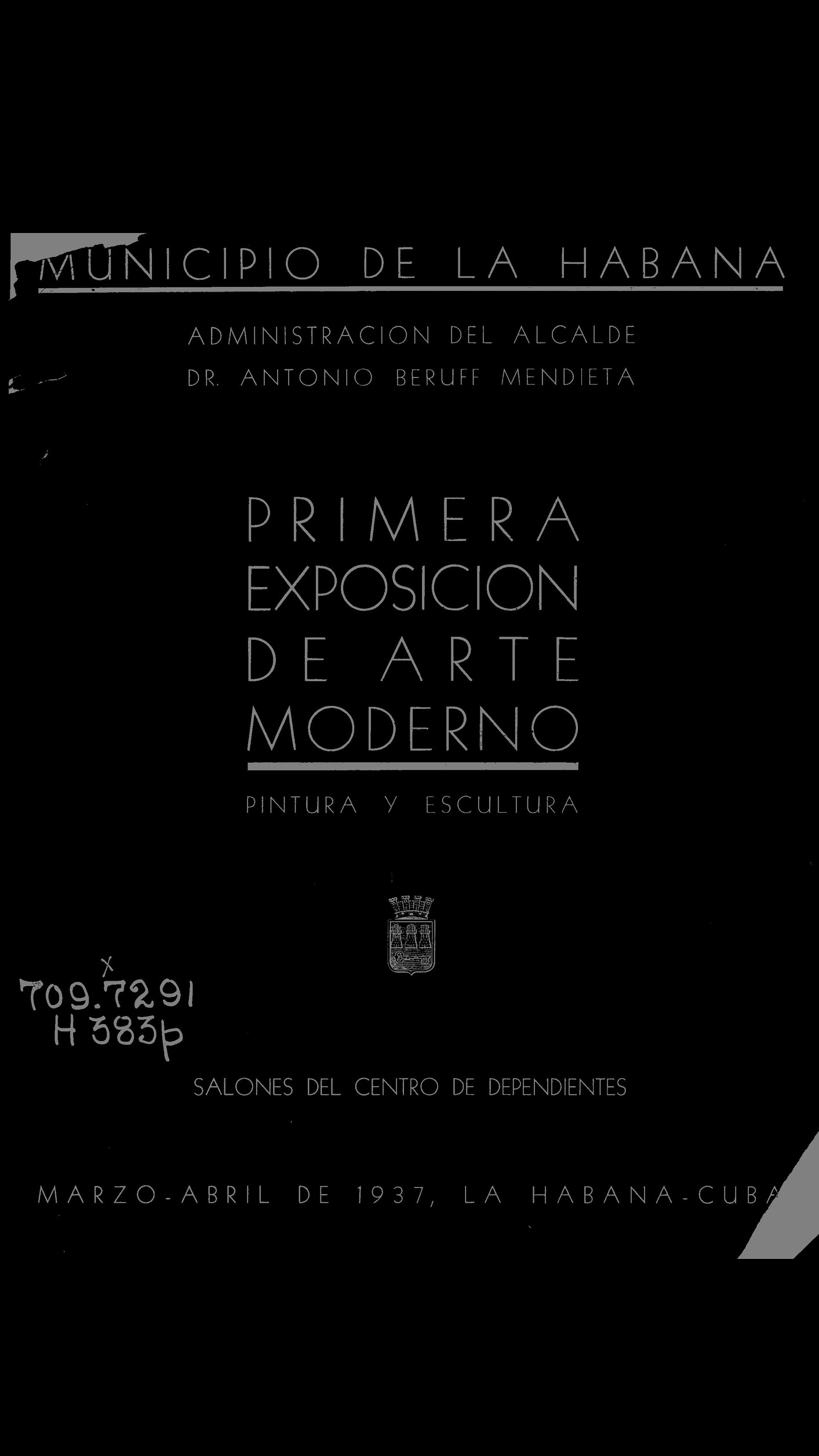
Herrera participates in the first exhibition devoted to modern art in Cuba, Primera Exposición de Arte Moderno, Pintura y Escultura, held at the Salones del Centro de Dependientes in Havana [March 23–April 8]. A large survey sponsored by Havana’s Department of Culture, it includes work by thirty-one painters—among them Abela, Bermúdez, Enríquez, and Peláez—and ten sculptors, including Herrera, who again exhibits Cristo.
Herrera presents four wood sculptures in Exposición de Escultura en Madera, a group show of works by Isabel Chappotín’s students at the Lyceum that opens on July 29. Other artists in the exhibition include Rita Maria de la Torre and Rita Longa (1912–2000), who would become a renowned sculptor.
Herrera meets Jesse Loewenthal (1902–2000) in the summer. Loewenthal, who has traveled to Cuba for health reasons, arrives bearing a letter to Carmela from Addison, who is then chief of NBC radio’s Latin American department in New York. Born in the Bronx to Louis Loewenthal of Berlin and Fanny Haas of Vienna, both Jewish immigrants, Loewenthal is a polyglot who speaks German, Yiddish, Spanish, French, and Italian, as well as some Arabic. (He also reads Latin and would later teach himself ancient Greek). A one-time Broadway actor and Objectivist poet, Loewenthal held a degree in English from City College of New York and taught at the prestigious Stuyvesant High School, a position he would hold until his retirement in the early 1970s. The couple soon begins a courtship nurtured by their mutual passion for literature, dance, and music. Loewenthal leaves Havana in early August with the promise to return in December. Unfortunately, finances prevent Loewenthal from returning for the holidays, so an intense exchange of letters (in English, with snippets of French and Spanish) ensues.